Certified Aircraft Appraisal in Los Angeles: The Definitive Guide
An authoritative analysis of the certified aircraft appraisal process for Southern California owners, lenders, and legal professionals. This guide provides a definitive framework for understanding the requirements, methodology, and regional factors that influence the value of aviation assets in one of the world's most dynamic markets.
Defining the Certified Aircraft Appraisal in the California Market
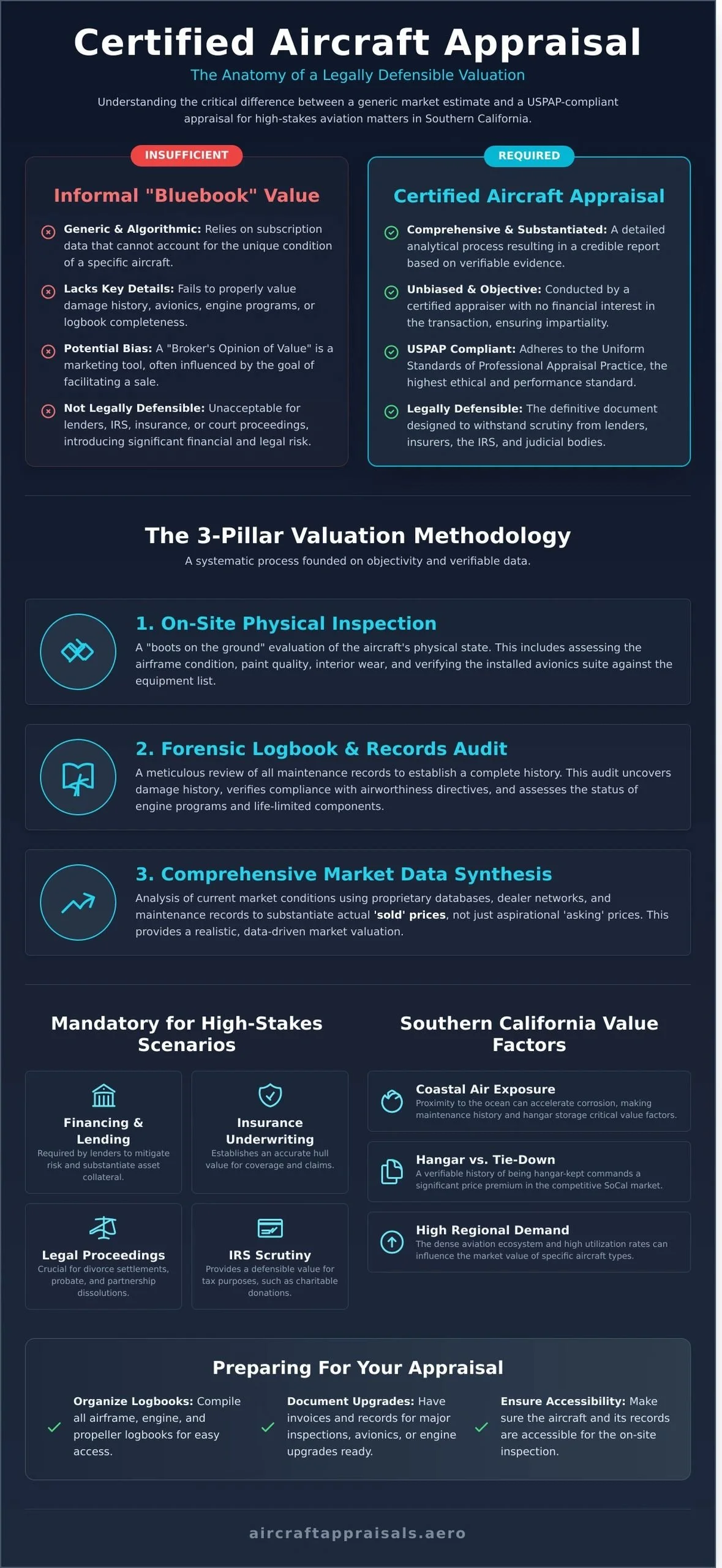
In the high-stakes financial and legal environments of Southern California, the term 'appraisal' carries significant weight. A certified aircraft appraisal is not a casual price estimate; it is a formal, legally defensible valuation report prepared in compliance with the Uniform Standards of Professional Appraisal Practice (USPAP). This distinction is critical for any transaction requiring precision, objectivity, and accountability.
Distinguishing Between a Price Estimate and a USPAP-Compliant Report: A price estimate, often derived from generic online tools or a broker's opinion, serves a marketing function. A certified appraisal, conversely, is an impartial, evidence-based audit of an asset's condition, history, and market position.
Why Southern California's Aviation Environment Demands Precision: The high density of operations at airports like Van Nuys (VNY), Burbank (BUR), and John Wayne (SNA) creates a complex market where factors like hangar availability, local demand, and specific operational histories have a magnified impact on value.
The Role of the Senior Certified Appraiser: A certified appraiser acts as an impartial auditor of value. They must have no financial interest in the outcome of a transaction, ensuring the final report is a product of clinical objectivity rather than sales motivation.
Legal Necessity for Certified Valuations: In California, a USPAP-compliant certified valuation is often mandatory for legal and financial proceedings, including probate court, marital dissolution, IRS filings for charitable donations, and securing asset-backed financing.
Certified Appraisal vs. Aircraft Bluebook Values
Subscription-based data services like Aircraft Bluebook and Vref are indispensable tools in the appraisal process, but they represent a starting point, not a final conclusion. These platforms provide a baseline value derived from standardized data sets and algorithms.
However, algorithmic valuations have inherent limitations in assessing the unique history of an individual airframe. They cannot adequately account for factors such as damage history, maintenance quality, avionics upgrades, or the specific demand signals in a localized market. Consequently, 'Bluebook' values often fail to reflect the true market premium or discount for an aircraft based and operated in the competitive Southern California ecosystem.
The Significance of USPAP Compliance for CA Lenders
The Uniform Standards of Professional Appraisal Practice (USPAP) is the congressionally recognized set of ethical and performance standards for the appraisal profession in the United States. For aviation assets, USPAP provides a rigorous framework that ensures valuations are credible, reliable, and unbiased.
For lenders and owners in Los Angeles, adherence to these standards is a primary mechanism for mitigating risk and liability. A USPAP-compliant report provides a defensible and well-documented opinion of value that can withstand scrutiny from financial auditors, regulatory bodies, and legal challenges. This stands in stark contrast to a "broker's opinion of value," which is inherently prepared with a sales objective and lacks the legal weight or impartiality of a certified appraisal.
The Methodology of a Professional Aircraft Valuation Audit
A certified aircraft appraisal is a systematic process that synthesizes three core pillars of analysis: a detailed physical inspection, a forensic audit of all maintenance records, and a comprehensive synthesis of current market data. The appraiser's primary responsibility is to maintain clinical objectivity, which requires that they have no financial stake in the aircraft's sale or transaction.
The chronological flow of a standard engagement begins with a formal engagement letter defining the scope of work. This is followed by the on-site inspection and records audit, market research, value conclusion, and the final delivery of the certified report. To determine value, senior appraisers use proprietary databases, industry networks, and official records to verify actual 'sold' prices, distinguishing them from the often inflated ‘asking' prices in public listings.
On-Site Physical Inspection Protocols
A physical inspection is a non-negotiable component of a true certified appraisal. This "boots on the ground" approach provides critical data that cannot be gathered remotely.
Condition Assessment: The appraiser meticulously assesses the condition of the airframe, paint, and interior, paying special attention to wear-and-tear patterns influenced by the California climate, such as potential corrosion from coastal basing.
Avionics and Equipment Verification: The installed avionics suite and any engine or airframe modifications are physically verified against the aircraft's official equipment list to ensure accuracy.
Local Presence: Conducting the inspection at hangars in Long Beach, Orange County, or Van Nuys provides invaluable context regarding the aircraft's operational environment and storage conditions.
Maintenance Logbook and Record Auditing
The aircraft's logbooks are its official biography, and their condition is a primary driver of value. An appraiser conducts a forensic audit of these records to uncover the complete history of the asset.
Identifying 'Missing Links': Gaps in maintenance history, missing logbook entries, or incomplete records can significantly devalue an aircraft by creating uncertainty for potential buyers and lenders.
Verifying Compliance: The audit verifies compliance with all applicable Airworthiness Directives (ADs) and tracks the status of major Service Bulletins, which can represent substantial future costs or added value.
Digital and Physical Cross-Reference: As maintenance tracking moves toward digital platforms, the appraiser cross-references these electronic records with the original physical logs to ensure a complete and consistent history.
Southern California Regional Factors Influencing Aircraft Value
An aircraft's value is not determined in a vacuum; its location and operational base play a significant role. The Southern California market has several unique factors that can influence an asset's final valuation.
The "California Premium": Aircraft based in California are often perceived as being well-maintained and are highly desirable in the global secondary market, sometimes commanding a regional premium.
Coastal Environments: Aircraft based at coastal airports such as Santa Monica (SMO) or John Wayne (SNA) require closer inspection for corrosion, which a qualified appraiser will carefully assess.
Market Demand Trends: The Pacific region exhibits specific demand trends, with a robust market for long-range business jets and high-performance piston aircraft used for regional travel.
MRO Proximity: The close proximity to major Maintenance, Repair, and Overhaul (MRO) facilities in Southern California can positively affect an aircraft's liquidity and maintenance-adjusted value.
Desktop vs. On-Site Appraisals: A Comparison
Clients often need to choose between a full on-site appraisal and a more limited desktop appraisal. While a Desktop appraisal can be sufficient for internal corporate reviews or preliminary financing discussions in Los Angeles, an On-Site inspection remains the gold standard for high-value transactions, litigation, and IRS reporting.
Feature: Desktop Appraisal, On-Site Certified Appraisal, Scope: Based on owner-supplied data, photos, and records. No physical inspection.Comprehensive physical inspection of airframe, interior, avionics, and logbooks. Cost: Lower fixed fee. Higher fixed fee, reflecting travel and inspection time. Defensibility Limited relies on assumed conditions. May not be accepted by all lenders or courts.Highest level of legal and financial defensibility. The industry standard. Best Use Case: Internal reviews, preliminary financing, and experienced owner estimates.Bank financing, insurance, legal proceedings, high-value transactions, and IRS filings.
Infrastructure and Hangarage Impacts in Los Angeles
The availability of hangar space, particularly at sought-after airports like Van Nuys (VNY), has a subtle but definite influence on asset value and liquidity. An aircraft with a guaranteed hangar spot at a major Los Angeles Basin airport is often more attractive to prospective buyers.
Furthermore, the "California-based" status is frequently used as a value-added marketing point in the global secondary market, implying a history of professional operation and maintenance. A certified valuation can also be instrumental in navigating California's complex sales and use tax regulations during a transaction, providing an independent and defensible basis for the asset's value.
Preparing Your Asset for a Certified Valuation
An aircraft owner can take several steps to facilitate a smooth and efficient appraisal process, helping minimize appraiser research time and associated hourly fees in complex cases. Proper preparation ensures that the aircraft's value is accurately and fully reflected in the final report.
Organize Maintenance Records: Presenting well-organized, complete maintenance logbooks is the single most effective way to streamline the appraisal process.
Document Recent Inspections: The value impact of recent major inspections, such as C-Checks on jets or engine overhauls on piston aircraft, should be clearly documented.
Highlight Upgrades: Provide complete documentation for recent avionics upgrades or interior refurbishments to ensure they receive maximum credit in the valuation.
Address Damage History: Transparency regarding any damage history is essential. A professional appraiser will uncover it during the audit; presenting it upfront with complete repair documentation is the only path to a credible and defensible report.
The Logbook Organization Checklist
For an efficient audit, please ensure your records are organized and complete. A well-prepared set of logbooks demonstrates a history of diligent ownership and can positively influence the appraisal outcome.
Categorize all engine, airframe, and propeller logs chronologically.
Ensure all FAA Form 337s (Major Repair and Alteration) are present and accounted for.
For a more detailed guide on technical preparation, please see our complete aircraft logbook reviewguide.
Evaluating Avionics and Connectivity Upgrades
The value of avionics is fluid and requires an expert understanding of current market demands. In today's market, high-speed connectivity installations like Starlink or Gogo are significant value enhancers, particularly for business jets. Conversely, older "glass cockpit" retrofits may show diminishing returns as technology advances. Furthermore, compliance with NextGen mandates (such as ADS-B Out) is now a baseline requirement for operation in most US airspace and is no longer considered a premium value-add.
OakTree Aviation Services: Senior Expertise in Southern California
OakTree Aviation Services provides technically authoritative, unbiased, and USPAP-compliant certified aircraft appraisals for the Southern California market. Led by Senior Certified Aircraft Appraiser Jeremy Cox, our firm brings over 25 years of industry experience to every valuation engagement.
Technical Authority: Decades of experience in the general and business aviation sectors provide a deep understanding of a wide range of aircraft, from high-performance piston aircraft to large-cabin jets.
Transparent Fixed-Fee Structures: We offer fixed-fee pricing for full transparency. Our fees are based on the aircraft's complexity, not its final value, ensuring complete objectivity.
Specialized Support: We provide specialized appraisal support to Los Angeles-based law firms, financial institutions, and high-net-worth individuals who require meticulous, defensible reporting.
The OakTree Promise: Our commitment is to deliver accurate, unbiased, and USPAP-compliant reports that meet the rigorous standards of lenders, courts, and the IRS.
Expert Witness and Litigation Support
Our expertise extends beyond valuation reports to include comprehensive litigation support. We provide clear, defensible expert witness testimony in California courts for a wide range of aviation-related disputes. Attorneys representing clients in marital dissolution, estate probate, or business partnership cases choose OakTree for our meticulous, evidence-based approach to aircraft valuation, which is essential for building a strong legal case.
Next Steps: Requesting Your Los Angeles Appraisal
Initiating the appraisal process is straightforward. The first step is to contact our office for a confidential consultation to discuss your valuation needs and receive a fixed-fee quote. During this initial consultation with Rick Rossner, you can expect a thorough review of your aircraft and the intended use of the appraisal to ensure the final report meets all necessary requirements.
Request a Certified Aircraft Appraisal in California
Frequently Asked Questions
Is acertified aircraft appraisaldifferent from a pre-purchase inspection? Yes, they are fundamentally different. A pre-purchase inspection is a detailed technical examination of the aircraft's mechanical and physical condition to determine its airworthiness. A certified appraisal is a financial audit to determine the aircraft's Fair Market Value. While an appraisal includes a physical inspection, it is not as mechanically in-depth as a pre-purchase.
How long does the on-site aircraft appraisal process take in Southern California? An on-site inspection typically takes about two hours at the aircraft's location. The full process, including research, data analysis, and report generation, is usually completed within 3-4 business days after the on-site visit.
Does USPAP compliance matter if I am not using the appraisal for a bank loan? Yes. USPAP compliance ensures the valuation is well-documented, impartial, and defensible. This is the standard required by the IRS for tax-related matters (donations, estate settlements) and by courts for legal disputes (divorces, partnerships). Using a USPAP-compliant report protects you in any formal proceeding.
What is the average cost of acertified aircraft appraisalfor a business jet? The cost is determined by the aircraft's complexity, not its value. A light jet will have a lower appraisal fee than a large-cabin, long-range jet due to the increased complexity of its systems, records, and global market analysis. We provide a fixed-fee quote after an initial consultation.
Can an aircraft appraisal be performed 'desktop only' for a divorce settlement? While a desktop appraisal can be performed, it is generally not recommended for contentious legal matters like a divorce settlement. The lack of a physical inspection can be challenged in court, and most legal professionals will insist on a full, on-site certified appraisal to ensure the highest level of defensibility.
How does damage history affect the certified value of my airplane? Damage history, even when properly repaired, typically results in a diminution of value. A certified appraiser will analyze the extent of the damage, the quality of the repairs (documented by FAA Form 337s), and current market sentiment to calculate an appropriate value adjustment. Transparency is key to an accurate assessment.
Why should I hire a California-based appraiser instead of a national firm? A California-based appraiser possesses intimate knowledge of local market dynamics, including hangar availability at airports such as VNY and SNA, regional demand trends, and the impact of the coastal climate. This nuanced, local expertise can result in a more accurate and relevant valuation.
What documents do I need to provide for a certified appraisal? To begin, you will need to provide the aircraft's specification sheet or equipment list. For the full appraisal, the appraiser will need access to a complete, organized set of maintenance records, including all airframe, engine, and propeller logbooks, as well as the aircraft's weight-and-balance data and flight manuals.